
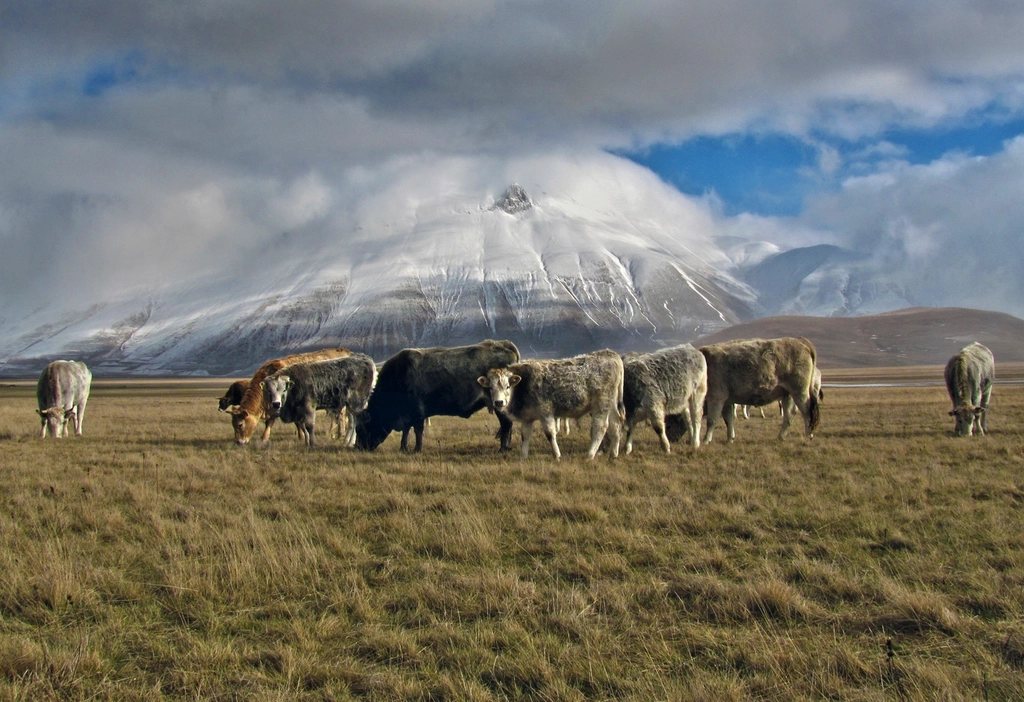

Norcia sits at 604 metres at the eastern edge of Umbria, where the Valnerina narrows and the road begins to climb toward the Monti Sibillini. The town is walled, flat and compact, laid out on the valley floor rather than perched on a hill like most Umbrian centres, and for centuries it has lived from pork and pulses. From here a single mountain road winds 28 kilometres east and up to Castelluccio, a stone village at 1,452 metres that looks down on the Piano Grande, one of the largest high plateaus in the Apennines. For a farm-stay guest based anywhere between Spoleto and Norcia, this is the day trip that explains the whole eastern side of the region.
The plateau and its short growing season
The Piano Grande is a former glacial lake bed, roughly 15 square kilometres of nearly flat karst basin at about 1,270 metres, ringed by bare grassy ridges. Water drains not through a river but through a sinkhole on the western side, which is why the plain floods in a wet spring and dries to pale gold by August. Snow lies for months; the road from Norcia can close after heavy falls between December and March, and Castelluccio is often cut off for days.
The farming calendar is compressed as a result. Lentils are sown as soon as the snow leaves the ground, usually in late March or April, and harvested from late July into August. The Castelluccio lentil is a small, thin-skinned pulse that grows without irrigation and is protected under a European geographical indication. It is planted in strips alongside other crops and wildflowers, and it is the mixture, not the lentil alone, that produces the famous colour.
When the fields bloom
The flowering, known locally as the fioritura, runs from roughly the last week of June to the middle of July, the peak shifting a week or two depending on how late the snow melted. Poppies bring the reds, cornflowers the blues, wild mustard and rapeseed the yellows, and the lentil plants add a faint white and violet haze. Seen from the road down from Forca di Presta or from the terrace of Castelluccio, the plain looks like a patchwork quilt stretched between the mountains.
Two practical notes. The fields are working farmland: walking into the strips damages the crop, so photographs are taken from the road edges and the marked tracks. And on July weekends the single access road fills by mid-morning; a weekday visit, or an arrival before 8, is the difference between a quiet plateau and a queue.
The 2016 earthquakes and what followed
Three major earthquakes struck the central Apennines within ten weeks in 2016. The first, on 24 August, had its epicentre south of here and destroyed Amatrice in Lazio. The second, on 26 October, hit the Marche side of the Sibillini. The third, on 30 October, measured 6.5 in magnitude with its epicentre just north of Norcia, the strongest event recorded in Italy since 1980. Because of the earlier shocks most people were already in temporary shelter and the town had no fatalities that day, but the damage was severe.
In Norcia the Basilica of San Benedetto, built over the traditional birthplace of Saint Benedict, collapsed to its facade. The medieval walls were breached in several places and much of the historic centre was declared unsafe. Castelluccio fared worse: most of the village was reduced to rubble, and its residents were moved to the valley for years. Reconstruction has been slow and uneven, but it is real. The basilica has been rebuilt using the recovered original stone, businesses in Norcia reopened in temporary wooden structures before moving back inside the walls, and in Castelluccio a new commercial building on the plateau allowed the lentil growers to keep working while the village itself is rebuilt. Visiting now means seeing scaffolding beside restored facades, and supporting a mountain economy that depends on visitors more than ever.
Farm stays on the plateau and in the valley
Accommodation on the Piano Grande itself is limited to a handful of family farms and a few rebuilt rooms in Castelluccio; nights at 1,300 metres are cool even in July, and the sky, with almost no light pollution, is one of the darkest in central Italy. Most guests stay lower, on farms around Norcia at 600 to 800 metres or in the Valnerina villages toward Cerreto di Spoleto, where the growing season is longer and the kitchens are fuller. Expect lentil soup with a thread of new oil, cured pork in every form, black truffle over pasta from December to March, and farro from the same slopes. A farm room for the flowering weeks needs booking months ahead; in September, when the plateau turns copper and the crowds are gone, availability is easy.
Walking up to the ridges
The Sibillini National Park, created in 1993, covers about 70,000 hectares across Umbria and the Marche, and the plateau is its natural trailhead. The classic climb starts at Forca di Presta, a pass at 1,536 metres south-east of Castelluccio, and follows a well-marked path up the open southern flank of Monte Vettore. A mountain hut at 2,240 metres marks the shoulder; the summit, at 2,476 metres the highest point in the range, is about three hours from the pass with 950 metres of ascent. There is no shade and no water on the way, so start early.
From the same shoulder a rocky path drops to the Lago di Pilato at 1,941 metres, a glacial lake in a cirque that holds a tiny red crustacean found nowhere else on earth. Access to the lakeshore has been restricted at times since the earthquake, so check the park notices first. Gentler options include the ridge walk from Forca Canapine at 1,541 metres, the loop across the Pian Perduto toward the Marche border, and simply following the farm tracks across the Piano Grande for two or three hours of flat walking with the whole amphitheatre of mountains around you.
- Season: late June to mid July for the bloom; September for empty trails; the road may be closed by snow between December and March.
- Distances: Norcia to Castelluccio 28 km, about 45 minutes; Spoleto to Norcia about 45 km; Perugia to Norcia about 100 km.
- Altitudes: Norcia 604 m, Piano Grande about 1,270 m, Castelluccio 1,452 m, Forca di Presta 1,536 m, Monte Vettore 2,476 m.
- Kit for the ridges: two litres of water per person, sun protection, a windproof layer even in summer, and a printed map.
A slow two-day plan
Arrive in Norcia in the afternoon, walk the walls and the rebuilt main square, and eat early. Leave for the plateau at first light, stop at the viewpoint on the descent for the wide view over the plain, and be walking from Forca di Presta by 8. Come down to Castelluccio for lentil soup around 2, then drive back to the valley as the plain turns gold. Done this way, the Piano Grande gives you a mountain, a village that refused to disappear, and a bowl of something grown within sight of your table.
