
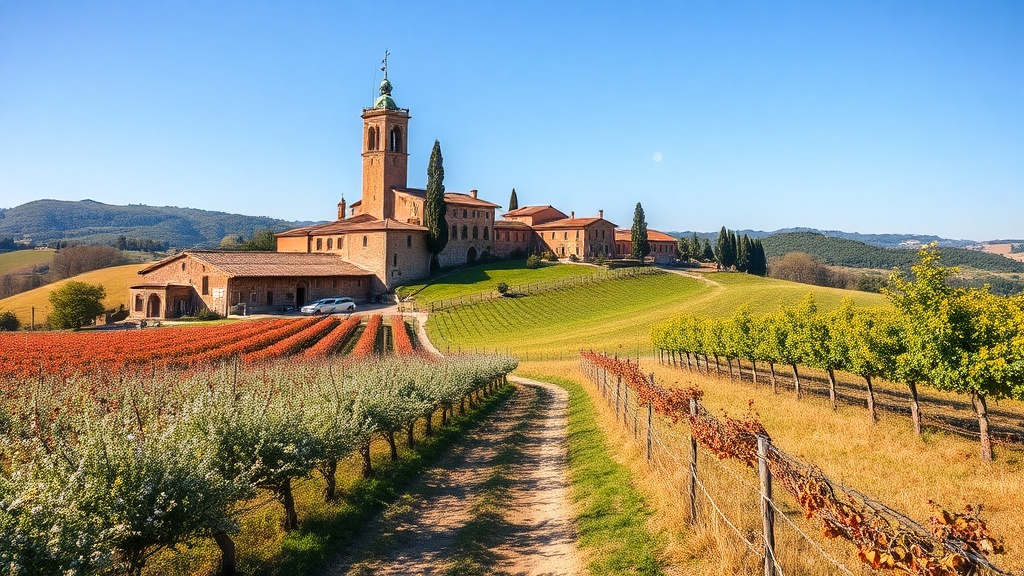

Southeastern Umbria is where the soft hills end. Past Spoleto the land folds into the Valnerina, the narrow valley of the Nera river, and then climbs to the lentil plain of Castelluccio and the bare ridges of the Monti Sibillini. Farm stays here are fewer and more scattered than around Montefalco or Assisi, and they are different in kind: colder, higher, closer to woods and water, and built around trout, black truffle, cured pork and lentils rather than wine and oil.
Spoleto, the Town at the Mouth of the Valley
Spoleto sits on a hill where the Umbrian valley narrows before the mountains. From the upper town the Ponte delle Torri, a fourteenth-century aqueduct bridge some eighty metres high, strides across the gorge to the wooded flank of Monteluco; the Rocca Albornoziana above it was a papal fortress and later a prison, and is now a museum. The cathedral square drops away below the town in a fan of steps, and the apse holds a fresco cycle by Filippo Lippi, who died here in 1469 and is buried in the church.
For a farm-stay visitor, Spoleto is the town for supplies, a train station and a night out. The Festival dei Due Mondi fills late June and the first half of July with music and theatre, and rooms within thirty kilometres fill with it, so either book for it or avoid those weeks. The old Spoleto to Norcia railway, closed in 1968, is now a walking and cycling path that climbs through tunnels and over viaducts into the Valnerina; the first stretch from Spoleto to the Caprareccia tunnel is a fine half day on foot.
Down the Nera: Gorge, Watermills and Trout
The Nera runs cold and fast and, unusually for central Italy, does not dry up in August. Its valley is a corridor of small fortified villages: Vallo di Nera on its spur, Scheggino on the water, Ferentillo with its two halves facing each other across the river and its abbey of San Pietro in Valle a few kilometres upstream. Trout farms line the river between Scheggino and Borgo Cerreto, and the fish appears on every farm table in the valley, grilled with a little oil, or filleted and dressed with black truffle in the classic pairing of the district.
At the southern end, near Terni, the Nera meets the Velino at the Cascata delle Marmore, a 165-metre waterfall in three drops that the Romans made in 271 BC by cutting a channel to drain the marshes above. The water is now released on a published timetable, because a hydroelectric plant sits upstream, so check the hours before driving down; when the sluices open, the sound arrives before the sight.
Norcia, Castelluccio and the Sibillini
Norcia is the market town of the high valley, walled and low, at about 600 metres. The earthquakes of 2016 destroyed the basilica of San Benedetto and damaged much of the town; rebuilding is well advanced but still visible, and the town’s pork butchers, the norcinerie that gave Italy the word, were among the first shops to reopen.
Above Norcia the road climbs through beech woods to the Piano Grande of Castelluccio, a flat plain at roughly 1,300 metres enclosed by treeless mountains. The lentils grown on it are sown in spring and harvested in late July and August; between them the plain flowers in stripes of poppy, cornflower and wild mustard from late June to mid-July, the Fiorita, which is the one time of year the road is crowded. The Monti Sibillini national park rises behind it to Monte Vettore at 2,476 metres, with marked paths starting from the plain.
Black Truffle, Lentils and the Valley Table
This is the one part of Umbria where truffle is a staple rather than a treat. The black winter truffle is dug from roughly December to March in the oak and hazel woods above the valley, and the summer scorzone from June to August; guided hunts with a dog and its handler last two or three hours and typically cost €50 to €90 per person, often ending at a kitchen table. Truffle here is grated over strangozzi pasta, folded into scrambled eggs, or spread on bread with oil and a little anchovy.
- Lenticchie di Castelluccio — simmered with garlic, celery and oil, never soaked, served with sausage or on toasted bread.
- Trota al tartufo — river trout with black truffle, the valley’s signature dish.
- Norcia cured pork — prosciutto IGP, coppa, and the salami the shops are named for.
A Farm Stay Here, Season by Season
Farms in the Valnerina are small, often a converted mill or a stone house with four or five rooms and a few hectares of pasture, walnut trees and vegetable garden. Many keep sheep or pigs and most cook. Expect a double room at €65 to €120 a night and dinner at €25 to €35, with wine from the Montefalco side of the mountains rather than from the valley, which grows almost none of its own.
Spring is late and green: the Nera is loud with snowmelt, the woods fill with wild asparagus, and the plain stays brown until June. Summer is the season for walking and for the Fiorita; nights are cool at altitude even when Spoleto is stifling, which is the main reason to be here in July. Autumn brings the lentil harvest, chestnuts, the first frosts on the plain and the start of the pork-curing season in Norcia. Winter is the truffle season and the emptiest time; roads to Castelluccio can close with snow, some farms close with them, and the ones that stay open are warm, quiet and cook better than at any other time of year.
Between the Gorge and the Mountains
The Valnerina rewards a slower kind of visit than the vineyard districts. Distances are short but roads wind, villages keep to themselves, and much of what is good here happens at a table after dark. Base yourself on one farm for four or five nights, walk part of the old railway, drive up to the plain on a weekday morning, eat trout by the river, and let the mountain hours set the pace. It is Umbria with the softness taken out, and for some visitors it is the part they come back to.
