
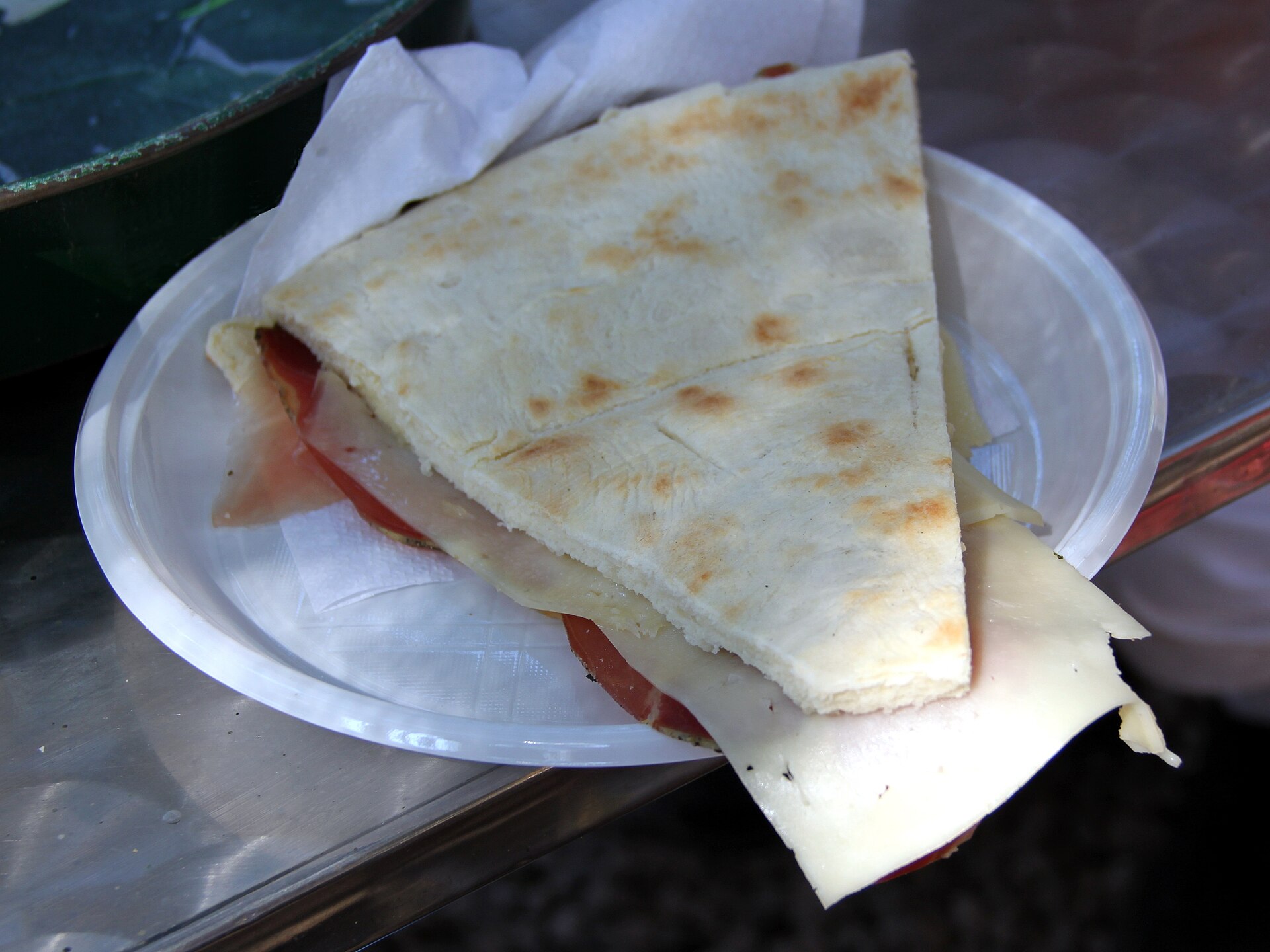

Torta al testo is the flatbread of the Umbrian countryside, cooked on a flat disc set over heat, split open and filled while still hot. On a farm stay it is one of the simplest ways to taste how rural kitchens have fed people for generations. This guide explains what it is, what goes in the dough, what ends up inside, and what to look for before you sit down to eat it.
- The bread takes its name from the testo, the flat disc it is cooked on, and traditional versions are made from flour, water, salt and a leavening agent.
- Typical fillings are cured meats, sausage, soft cheese or cooked greens, so there is usually something for most diets.
- It is best eaten hot, soon after cooking, so ask when it will come off the heat.
What is torta al testo, and what is the testo?
Torta al testo is a round, flat, savoury bread. Despite the word “torta”, it is not a cake: it is closer to a thick flatbread that you cut into wedges or split through the middle like a pocket. In parts of Umbria it goes by other names. You may see crescia around Gubbio, and ciaccia in the Upper Tiber Valley.
The name comes from the cooking surface. The word testum was used for a clay tile employed in ancient times to cook flatbreads, and the Latin root explains why the bread carries the name of its tool. In the traditional setup, the cooking surface is a round cast-iron plate, and one source describes such plates as roughly 3 cm thick. In the older tradition, the bread was cooked on a stone placed over hot coals in the fireplace.
That detail matters for how the bread turns out. A heavy disc holds heat and delivers it evenly, which is what gives a good torta its dry, lightly spotted surface and a soft interior. Many Umbrian homes today use a cast-iron plate on the stove top, so you may well be served a version cooked that way rather than over an open fire. Both are legitimate.
A practical point if you ask to see it being made: a good cook heats the disc thoroughly before the dough touches it, and a cold surface is the classic cause of a torta that is dry outside and underdone inside.
What goes into the dough?
The traditional dough is plain: flour, water, salt and some form of leavening. Beyond that, recipes vary from family to family and from area to area, which is normal for a dish handed down at home rather than standardised.
The history explains the simplicity. Farmers baked leavened bread in a wood oven only once or twice a fortnight, because firing the oven took time and effort that they preferred to save for the fields. A flatbread cooked on a disc was a quick way to have fresh bread every day. In earlier times the torta was unleavened. It was also useful for fieldwork such as harvesting and grape picking, when it could fill the stomach even without anything to eat alongside it.
Modern versions differ in a few ways you may notice:
- Leavening: some cooks use baking soda or an instant raising agent for savoury bakes, others use yeast and a long rise of a few hours.
- Enrichment: some households add olive oil, eggs or a little cheese to the dough, which makes the bread richer and softer.
- Thickness: the discs are generally rolled out fairly thick, around the 1 cm mark in some home recipes, and pricked with a fork before cooking so they do not puff up.
If you want a plain, old-style torta, say so when you book or order. Most farm kitchens will tell you which version they make.
What fillings should you expect at the farm table?
The torta is usually split while hot and filled, or served in wedges beside a platter of antipasti or a main dish such as chicken cooked hunter-style. The classic fillings are short, simple lists.
- Cured meats: ham or prosciutto, including prosciutto from Norcia, is a common choice.
- Sausage: grilled sausage, or sausage paired with cooked greens.
- Soft and sheep’s-milk cheese: stracchino with rocket is a frequent pairing, and ham with cheese or pecorino also turns up.
- Cooked greens: spinach, Swiss chard, chicory or rapini, sautéed with garlic and oil.
The greens version deserves attention if you travel with a vegetarian. Greens are traditionally gathered from fields and ditches, and today cultivated chard or spinach often stands in for the wild mix. Wild chicory gives a more bitter, complex flavour. Cultivated greens give a milder, more predictable result. Neither is wrong, so it comes down to what you like.
When you are choosing at a menu or table, a few signs point to a good filling. The greens should be well drained and glossy rather than wet, because excess water turns the bread soggy from the inside. Meats and cheese should be generous but not stacked so high that the bread cannot hold them. And the bread should arrive warm, not reheated and limp.
For a drink, the bitterness of greens suits a fresh, acidic white. A dry Orvieto is the natural match, and a light young red works better than a heavy one if sausage is in the filling.
How does it differ from piadina, and when should you look for it?
The comparison with piadina from Romagna comes up often, and it is fair. Both are flat rounds cooked on a hot surface and filled with cured meat, cheese or greens. One recipe from an Assisi agriturismo describes torta al testo as not dissimilar to the Romagna piadina and also not far from a wheat tortilla.
The differences are in the details. The leavening and the enrichments, such as eggs, cheese or oil, also vary by household in a way that a standardised commercial flatbread does not.
On timing, it is a staple more than a seasonal dish, so you can ask for it at any time of year. It is both an everyday street food and a festive food. It is also served at events on the shores of Lake Trasimeno, where it is part of the local food culture. If you are building a trip around eating it, check with your host about when it is made fresh, since it is at its best straight from the heat. It keeps a day wrapped in a cloth but loses its softness and dries out, and reheating on a grill or low flame only partly restores it.
A short checklist before you book a farm stay for the food:
- Ask whether the torta is made fresh on the day, and at what time of day.
- Ask which cooking surface is used, if that matters to you.
- Ask what fillings are standard, and whether a greens-only plate is possible.
- If you want to learn the method, ask whether the kitchen runs cooking sessions, since some farms offer small cooking schools.
Used this way, the torta gives you a quick, honest read of a farm kitchen: simple ingredients, good heat and careful handling are all you need to judge it.
Related reading
- Local Food & Wine in Umbria: A Taste of Simplicity and Soul
- The Art of Handmade Pasta in Umbrian Farm Kitchens
Sources
- Recipe: Torta al Testo from Umbria (dreamofitaly.com, accessed 2026-11-09)
- Torta al testo umbra, autentico street food, Italia da mordere (greatitalianfoodtrade.it, accessed 2026-11-09)
- Torta la testo umbra – Lo scrigno del buongusto (blog.giallozafferano.it, accessed 2026-11-09)
- Umbrian Torta al Testo with Wild Herbs – Recipes (wikicibo.com, accessed 2026-11-09)
Photo: Torta al testo ham cheese, by LepoRello, CC BY-SA 3.0 (Wikimedia Commons)
