
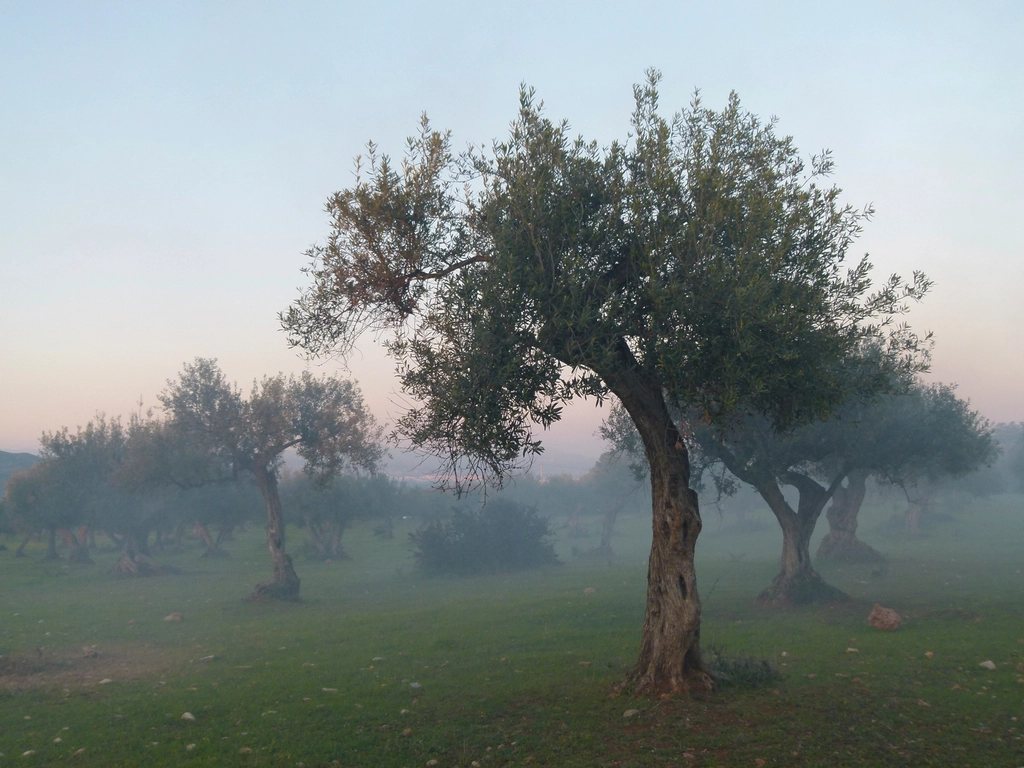

November is the month most guidebooks skip and most farmers would choose. The tour buses have gone from Assisi, the lanes between the olive terraces are full of nets and ladders, and the first pressing of the year is running in every mill from Trevi to Spoleto. It is also wet, short-lit and, in the valleys, often foggy until noon. A farm stay in November is a different holiday from one in June, and it is worth knowing what you are choosing before you book.
The weather, honestly
November is on average the wettest month of the year in Umbria. Perugia, at 493 metres, records roughly 90 to 100 millimetres of rain across the month and daytime highs around 13 degrees, dropping to 5 or 6 at night; the hill towns above 500 metres run a degree or two cooler, and the Sibillini foothills around Norcia can see the first snow by the end of the month. Days shorten fast: by late November the sun rises around 7 and sets before 5, which leaves about nine and a half hours of usable light.
The characteristic feature is fog. The Valle Umbra between Perugia, Assisi, Foligno and Spoleto is a flat basin, and on still nights cold air pools there and condenses into a grey blanket that can last until midday. The same happens in the Tiber valley and around Lake Trasimeno. The hill towns sit above it, so a morning in Assisi, Spello, Montefalco or Todi often means bright sun and a sea of white below, with only the towers of the next town breaking the surface. A farm in the valley means damp grey mornings; one on a hillside above 400 metres looks down on them.
The olive harvest and the new oil
This is the main reason to come. Umbrian olives are picked early, while still green or just turning, from the second half of October through November, and the oil is what the region is known for: green, grassy, bitter and peppery enough to catch in the throat. Picking is done by hand with small rakes and by mechanical shakers, with nets spread under the trees, and on many farms guests can join a morning of it. The olives go to the mill within a day or two, because fruit left in crates loses its edge quickly.
The mills themselves, called frantoi, are the social centre of the month. Most run day and night in the peak weeks, farmers queue with their trailers, and the smell of crushed fruit fills the yard. The tradition is to taste the new oil, called olio nuovo, on a slice of bread toasted over the fire and rubbed with garlic; the pepperiness is strongest in the first weeks and fades over the winter. Across Umbria, November weekends bring open days at the mills and in the olive villages, with tastings, walks through the groves and local markets. The five recognised olive-growing zones run from the Trasimeno hills to the Assisi-Spoleto slopes to the Orvieto and Amerini hills, each with a slightly different taste, and a farm host will happily line up two of them side by side for you.
Truffle season, both kinds
November is the one month when Umbria’s two great truffles overlap. The white truffle, the expensive one, is found from late September to the end of December, mostly in the upper Tiber valley around Citta di Castello and the hills toward Gubbio, and it is at its best in November. The black winter truffle, the one Norcia and Spoleto are known for, starts its season in the second half of November or at the beginning of December and runs to mid March. A guest in the last week of the month can therefore eat white truffle shaved raw over egg pasta one evening and black truffle warmed into a sauce the next, and pay considerably less for the second.
Truffle hunts with a dog and a licensed hunter are offered through many farms and run in the morning, when the ground is damp and the scent carries. Dress for mud. The woods are also full of porcini after the rains, and this is chestnut season in the Valnerina and the Monti Martani, roasted in the piazzas on Sundays.
What is closed and what is open
The honest picture is mixed. Major sites in Assisi, Perugia, Orvieto and Spoleto stay open all year, though with shorter winter hours, often closing around 5 or 6. Smaller museums and village churches may open only on weekends or on request. Lake Trasimeno ferries run a reduced timetable and some boat services stop altogether. Mountain refuges in the Sibillini close, and the road to Castelluccio can be shut by snow from late November. Restaurants in the tourist towns thin out, but the ones that stay open are the ones locals eat in, and they are cooking the season: soups of chickpeas and farro, cardoons, roast pork, game.
Among farm stays, perhaps a third close from early November until Easter. Those that stay open are usually working farms with animals or olives that need attention anyway, and they are at their most genuine: fewer guests, a fire lit in the common room by four in the afternoon, the family eating with you more often than not. Ask two things when booking: whether dinner is served on the nights you want it, since many farms cook only for a minimum number of guests, and whether the rooms have heating you can control rather than a wood stove alone.
Packing and driving on wet hill roads
Bring a proper waterproof jacket, boots with grip for muddy groves and stone streets, warm layers for evenings that can feel colder indoors than out, and a headtorch, because farm lanes are unlit after dark. Sunglasses are not a joke; on the hilltops above the fog the light is sharp.
- Roads: from 15 November until 15 April many Umbrian roads, and all the mountain routes toward Norcia and the Sibillini, require winter tyres or chains in the car; a hire car should come equipped, so check before driving away.
- Fog: use dipped headlights, not full beam, keep well back from the tail lights ahead and expect visibility under 50 metres on the valley floor in the early morning.
- Leaves and mud: wet leaves on the tarmac and tractor mud at field gates make the hairpin lanes up to the hill towns slippery; drive in a lower gear and brake before the bend, not in it.
- Daylight: plan to be on unfamiliar farm tracks before 4.30 in the afternoon.
Why it is worth it
A November week on an Umbrian farm has a rhythm that summer cannot offer. Mornings are slow because the fog says so. Late mornings are for the groves, the mill or the market. Afternoons are for one hill town, empty and lit gold for an hour before the light goes. Evenings are long, indoors, at a table where the oil is a fortnight old and the truffle came out of the ground that morning. It rains, sometimes all day, and then the sky clears and the Sibillini appear with their first snow. Bring the boots.
Read next: Agriturismo in Italy: What the Label Means and How to Pick a Real Farm Stay
